OUR SOLUTIONS

Advanced Agrivoltaics
Renewable energy and agricultural continuity can coexist, in an integrated vision of the land
Advanced agrivoltaics represents today one of the most interesting developments in the field of solar energy: a model in which electricity production sits alongside agricultural activity, without replacing it. In this context, the land continues to maintain a productive function, while the energy project is developed in a way that is consistent with the characteristics of the site and the needs of agricultural activity.
For GDS Sole Italie, agrivoltaics is not just a technical solution, but a genuine design approach that requires a balance between energy development, land use, water management and the continuity of agricultural activities. From this vision comes the value of the project: building plants that integrate into the territory, following a structured, sustainable and long-term approach.
GDS Sole Italie develops agrivoltaic projects according to a logic that involves all interested parties — landowners, farmers, specialist professionals and public institutions — enhancing every phase of the process, from design to implementation. The objective is to build plants capable of producing renewable energy while, at the same time, maintaining meaningful agricultural production, preserving a concrete connection with the agricultural vocation of the land.
The current Italian regulatory framework (from the guidelines on agrivoltaic plants defined by MASE in 2022, to Legislative Decree 190/2024 integrated with Law 4/2026) has introduced clear technical and design requirements to distinguish advanced agrivoltaics, recognised as the solution most compatible with the protection of agricultural activity and, consequently, generally permitted in authorisation processes.
GDS Sole Italie plants
Ground-mounted photovoltaics and agrivoltaics: environmental integration practices
What is advanced agrivoltaics?
An agrivoltaic plant goes beyond the concept of a photovoltaic plant installed on agricultural land: it is a system designed to maintain, and in some cases improve, the agricultural productivity of the land, while simultaneously producing renewable energy. Configurations can vary greatly depending on the type of farming practised. However, structures are systematically elevated to allow the passage of agricultural machinery, soil cultivation and livestock grazing, beneath and between the modules.
The term "advanced" was introduced in Italian regulations to indicate specific minimum technical requirements in terms of structures, heights, maintained agricultural surfaces, monitoring and productive continuity.
The founding principle is co-activity: energy production and agricultural activity coexist on the same soil, at the same time, thanks to structures designed not to interfere with crop cycles, the passage of agricultural machinery or livestock grazing.
Advanced agrivoltaics: technical requirements
How does an advanced agrivoltaic plant work?
The structure of an advanced agrivoltaic plant differs from that of a traditional photovoltaic plant in several design aspects.
Height and spacing of structures. Photovoltaic modules are installed on elevated solar-tracking structures, at a height that allows the passage of agricultural machinery, soil cultivation and livestock grazing. The distance between rows of panels (the pitch) is defined based on the type of farming practised (planned crops, livestock requirements) and the equipment needed for both agricultural management and plant maintenance. In advanced agrivoltaic projects, the pitch is generally greater than in a traditional ground-mounted photovoltaic project.
Tilt and density of panels. The tilt of the modules, installed on single-axis north-south tracking structures, and the arrangement of the rows are defined by taking agricultural requirements of the site as the primary consideration, not just energy yield. The objective is to create a favourable microclimate by offering protection against climate risks (hail, frost, drought). For example, partial shading can reduce heat stress on crops in areas most exposed to drought, without compromising agricultural production.
Crop continuity and livestock. Agricultural activity does not stop or become a token presence. The advanced agrivoltaic project includes a crop and livestock management and monitoring plan that accompanies the plant throughout its operational life.
The agricultural project as the starting point. In advanced agrivoltaics, the starting point is not the photovoltaic plant, which agriculture is then adapted to. The starting point is the agricultural vocation of the land, and the plant is designed around it. This is a design distinction before it is a regulatory one.
Enhancing land value with an agrivoltaic project
For a landowner, an agrivoltaic project represents a concrete opportunity to enhance the value of their land within a structured process managed by a specialist operator. In this model, the land is not considered merely as available surface area, but as part of an integrated project that combines energy development, agricultural activity and a long-term vision.
GDS Sole Italie identifies and assesses agricultural land suitable for the development of agrivoltaic plants, proposing flexible and tailored contractual arrangements. Options include outright land purchase or the establishment of a long-term surface right. In both cases, the landowner can rely on a single point of contact for contract negotiation, project development, implementation and management.
What agricultural land does GDS Sole Italie look for?
- Minimum area:
- Location:
- Soil characteristics:
Contractual arrangements
GDS Sole Italie offers landowners two options for acquiring use of the land and developing the agrivoltaic plant:
- Land purchase:
- Surface right (DDS):
In both cases, the landowner does not need to make any investment. Design, development, financing, construction and management of the plant are entirely the responsibility of GDS Sole Italie.
What happens at the end of the plant's life?
At the end of the operational period, GDS Sole Italie carries out the dismantling of the plant and the restoration of the land to its original condition. This commitment is an integral part of the project and is formalised both administratively and contractually.
Want to understand in detail how the land transfer works, which documents are required and what to expect at each stage? Go to the guide for landowners.
Transferring your land for a photovoltaic or agrivoltaic plant
GDS Sole Italie also works with local partners (professionals, agents, intermediaries) who know the territory and can identify land opportunities or connect interested landowners. If you operate in this field, find out how to work with us.
Become a GDS Sole Italie partner
The role of the farmer in an agrivoltaic project
Landowner and farmer are not necessarily the same person
In agrivoltaic projects, the landowner and the farmer are not necessarily the same person. Agricultural activity on the land may be managed by the owner, if they are themselves a farmer or hold an agricultural business, or entrusted to a third party, based on contractual arrangements.
For this very reason, the development of an agrivoltaic project requires a clear definition of the different roles and coordination among all parties involved. The value of the project also stems from the ability to integrate agronomic expertise, production needs and energy objectives within a common, structured and sustainable process.
In GDS Sole Italie's agrivoltaic model, agricultural activity is entrusted to a farmer, remunerated by GDS Sole Italie for the management of crops or livestock, while GDS Sole Italie handles the development, financing, construction and management of the energy component. The two activities coexist in the same space, but draw on different areas of expertise that must be integrated in a coherent way.
For this reason, the farmer is involved from the earliest stages of the project. Decisions such as structure height, panel spacing and tilt must be defined based on the planned agricultural activity and the farming practices to be maintained. The objective is not to adapt agriculture to a pre-defined configuration, but to design the plant in a way that is compatible with agricultural work and with the productive vocation of the land.

What changes and what stays the same in agricultural activity
What stays the same: agricultural activity remains fully productive. It continues to be carried out according to ordinary agronomic practices and schedules, regardless of whether it is managed by the owner or a third party. The farmer retains responsibility for managing crops or livestock and uses their own equipment and expertise.
What changes: the land is shared with an energy infrastructure that introduces a new configuration of agricultural space. The presence of photovoltaic structures partially modifies the microclimatic conditions of the land, influencing crop exposure to weather agents and the variability of certain environmental factors. In many contexts, these changes can translate into operational advantages, contributing to better management of climate extremes and risks related to weather events such as heatwaves, drought, hail or frost.
Benefits for the farmer
Climate adaptation: partial shading from the panels helps to modulate the microclimatic conditions of the cultivated area, affecting factors such as solar radiation, temperature and rainfall distribution. This can support more effective management of extreme climate events and increase the resilience of the farming business.
Stable long-term income: the farmer is engaged by GDS Sole Italie to manage the agricultural activity provided for in the project and receives contractually defined remuneration. The operational lifespan of the plant, generally at least 30 years, offers a significant horizon of economic stability.
Income diversification: revenues from agricultural activity carried out within the project complement the other income streams of the farming business or the farmer, reducing dependence on a single activity.
Continuity and consolidation: signing a multi-year contract with GDS Sole Italie guarantees long-term economic visibility, supporting more predictable and structured management of agricultural activity.
Advanced agrivoltaics for Farmers
Integrated expertise for complex agrivoltaic projects
For investors, institutions and stakeholders, advanced agrivoltaics requires an approach capable of integrating energy development, agricultural continuity and compliance with the regulatory framework, including the dedicated agrivoltaic guidelines. GDS Sole Italie develops and manages this type of project with a structured vision, based on the coordination of the various phases and attention to the overall sustainability of the intervention.
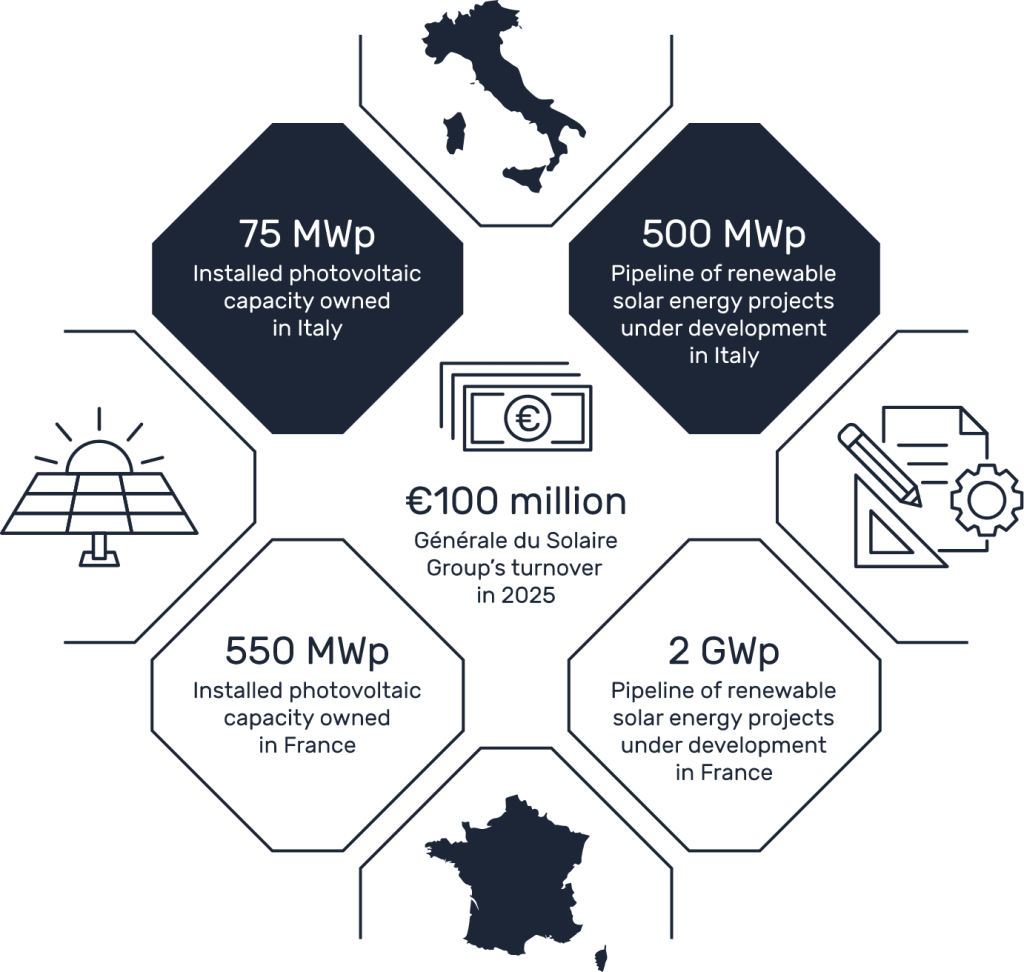
As the Italian subsidiary of the Générale du Solaire group, GDS Sole Italie is part of an organisation that covers development, financing, construction, operation and plant management. In the agrivoltaic field, this integrated approach is particularly relevant, as it allows the project to be structured while keeping together the technical component, agricultural activity and regulatory requirements.
Discover one of our projects in Italy and GDS Sole Italie's experience applied in the field.
GDS Sole Italie: Badia Polesine case study
Frequently asked questions
What exactly is advanced agrivoltaics and how does it differ from ground-mounted photovoltaics?
Advanced agrivoltaics is a system that integrates photovoltaic energy production and agricultural activity on the same land, in compliance with the technical requirements defined by Italian regulations (Legislative Decree 190/2024 integrated with Law 4/2026 and the MASE agrivoltaic guidelines).
How many hectares are needed for an agrivoltaic project with GDS Sole Italie?
GDS Sole Italie seeks agricultural land from 20 hectares in area. The actual extent depends on the characteristics of the site and the planned agricultural project.
Is advanced agrivoltaics suitable for any type of crop?
Compatibility depends on the type of agricultural activity and the technical configuration of the plant. Some crops and activities lend themselves better than others to coexistence with agrivoltaic structures. GDS Sole Italie carries out a case-by-case assessment, with the support of an agronomist, based on the existing or planned agricultural activity.
Who handles the authorisations?
GDS Sole Italie manages the entire permitting process, from the feasibility study through to obtaining the authorisations required for construction and operation of the plant. The landowner and the farmer do not need to handle any administrative procedures or bear any related costs.
How long does an agrivoltaic plant last?
An agrivoltaic plant has an operational life of approximately 30 years. At the end of this period, GDS Sole Italie carries out the dismantling of the plant and the restoration of the land to its original condition. The commitment to reversibility is an integral part of the project and is formalised both administratively and, where applicable (in the case of a surface right with the owner), contractually.