Advanced Agrivoltaics

Advanced agrivoltaics for Farmers

How the GDS Sole Italie model works
GDS Sole Italie designs, finances, builds and operates the agrivoltaic plant while the farmer manages agricultural activity on the same land.
For the farmer, the model is straightforward: no investment required, agricultural activity maintained, and stable contractual compensation for at least 30 years.
Your role in the agrivoltaic plant
GDS Sole Italie is the plant developer and operator: it handles design, financing, construction and operational management of the photovoltaic component.
The farmer manages crop or livestock activity on the same land. The two activities are distinct and run in parallel.
Regulations require that an advanced agrivoltaic plant guarantee the continuity of crop or livestock activity. GDS Sole Italie fulfils this requirement by contractually entrusting agricultural management to an agricultural partner: either someone who already works the land or a farming business identified locally.
GDS Sole Italie
- Designs, finances and builds the agrivoltaic plant
- Manages the technical maintenance of the plant
- Collects revenue from energy sales
- Covers all costs related to agricultural activity
- Guarantees land restoration at the end of the project
The farmer
- Manages agricultural activity on the land (crops or livestock)
- Maintains agronomic practices
- Invoices GDS Sole Italie for the agricultural service
- Receives stable contractual compensation
- Bears no costs or financial risks related to the plant
Agricultural activity: what changes (and what doesn't) with the panels
On an operational level, the main change concerns the physical configuration of the field, due to the presence of photovoltaic panels installed on elevated structures. The plant is designed to be compatible with existing agricultural machinery, soil cultivation and livestock grazing: the minimum clear height from the ground and the spacing between rows are defined based on regulatory requirements and the operational needs of the agricultural activity.
Advanced agrivoltaics: technical requirements
What stays the same
- The farmer remains responsible for agronomic management
- The agricultural calendar remains unchanged
- The farmer continues to define the agronomic plan
What changes
- The physical structure of the field, with the presence of elevated installations
- The microclimate beneath the panels, which can reduce water requirements during hot seasons (more moderate temperature, lower evaporation, less dry soil)
- In some configurations, sowing and harvesting operations may require coordination with the agrivoltaic plant manager, to adjust module positioning during the passage of machinery
Which crops and activities are compatible?
Compatibility between an agrivoltaic plant and agricultural activity depends on the design. GDS Sole Italie adapts each plant to the characteristics of the agricultural activity already in place or planned: type of activity (crops or livestock), type of crop or livestock, machinery dimensions, irradiation requirements, etc.
| Activity / Crop | Compatibility | Notes |
|---|---|---|
| Sheep / cattle grazing | High | Shade improves animal welfare; animals benefit from cooler vegetation between and beneath the panels. |
| Olive growing | High | Varieties typical of central and southern Italy tolerate partial shading well on the lower part of the trees. |
| Truffle cultivation | High | Shade cast by the panels promotes truffle growth at the base of truffle-producing trees. |
| Hazelnut groves | High | Species naturally adapted to partial shade. |
| Shade-tolerant vegetables | High | Lettuce, spinach, artichokes, aromatic herbs, strawberries, raspberries. |
| Arable crops (cereals, forage) | Medium-High | Requires adequate row spacing for machinery passage. |
| Vineyards | Medium | Depends on variety and row orientation; to be assessed case by case. |
Sheep / cattle grazing
High
Shade improves animal welfare; animals benefit from cooler vegetation between and beneath the panels.
Olive growing
High
Varieties typical of central and southern Italy tolerate partial shading well on the lower part of the trees.
Truffle cultivation
High
Shade cast by the panels promotes truffle growth at the base of truffle-producing trees.
Hazelnut groves
High
Species naturally adapted to partial shade.
Shade-tolerant vegetables
High
Lettuce, spinach, artichokes, aromatic herbs, strawberries, raspberries.
Arable crops (cereals, forage)
Medium-High
Requires adequate row spacing for machinery passage.
Vineyards
Medium
Depends on variety and row orientation; to be assessed case by case.
If the crop currently grown on the land is not fully compatible with the agrivoltaic project, GDS Sole Italie assesses the most suitable solutions together with the farmer, including redefining agricultural activities, in order to ensure continuity and alignment with the farmer's productive requirements.
What you get from working with GDS Sole Italie
1. Contractual compensation
The farmer invoices GDS Sole Italie for labour and management costs. Compensation is fixed contractually for the entire duration of the project.
2. Stability for 30+ years
The operational lifespan of agrivoltaic plants is at least 30 years: a stable income horizon, with no dependence on agricultural market prices.
3. Zero investment costs
GDS Sole Italie covers all costs related to agricultural activity. The farmer bears no financial risks.
How to work with GDS Sole Italie
The relationship between GDS Sole Italie and the farmer can begin in two ways:
The farmer proposes their land
It is possible to put forward one's own land and availability to manage agricultural activity. GDS Sole Italie assesses technical compatibility and project feasibility.
GDS Sole Italie identifies the farmer
When GDS Sole Italie develops a project on land already acquired, it looks locally for a farmer or farming business suited to managing the activity. The search takes place through the local intermediary network and the site's direct channels.
What are the steps of an agrivoltaic project for a farmer?
The development of an agrivoltaic project can vary significantly depending on project complexity and the permitting process. As a general indication, from first contact to operational management of the agrivoltaic plant, the process may take between 3 and 5 years. The project validation phase is the most variable.
Step 1
Contact
The farmer contacts GDS Sole Italie through the form on the website or is identified through the local network.
Step 2
Technical assessment
GDS Sole Italie assesses the compatibility of the land: area, location, current agricultural activity, irradiation, access to the electricity grid.
Step 3
Agrivoltaic project validation
The agronomic plan, contractual structure and agrivoltaic project are agreed upon with the farmer. The project is then submitted to and authorised by the competent authorities.
Step 4
Contractual agreement
Once the project is approved, an agricultural management contract is signed for the entire useful operational life of the agrivoltaic plant.
Step 5
Plant construction
GDS Sole Italie installs the agrivoltaic structures. Agricultural activity continues concurrently during the construction phase.
Step 6
Operational management
The farmer manages agricultural activity; GDS Sole Italie manages the energy component of the plant for the entire contractual duration.
Integrated expertise for complex agrivoltaic projects
For investors, institutions and stakeholders, advanced agrivoltaics requires an approach capable of integrating energy development, agricultural continuity and compliance with the regulatory framework, including the dedicated agrivoltaic guidelines. GDS Sole Italie develops and manages this type of project with a structured vision, based on the coordination of the various phases and attention to the overall sustainability of the intervention.
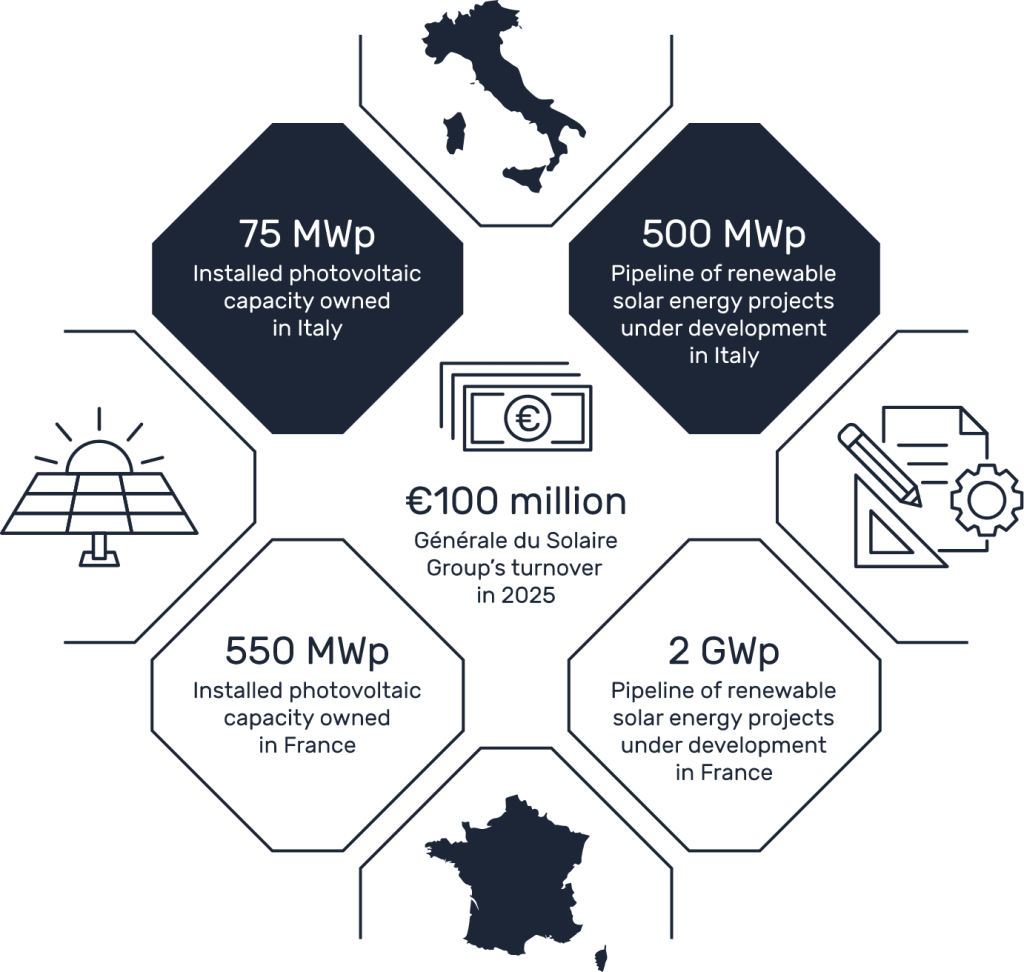
As the Italian subsidiary of the Générale du Solaire group, GDS Sole Italie is part of an organisation that covers development, financing, construction, operation and plant management. In the agrivoltaic field, this integrated approach is particularly relevant, as it allows the project to be structured while keeping together the technical component, agricultural activity and regulatory requirements.
Frequently asked questions
Can I continue to grow what I currently grow?
It depends on the agricultural activity and the characteristics of the land. GDS Sole Italie assesses, together with the farmer, the compatibility of the agronomic plan with the agrivoltaic project. Where necessary, the agrivoltaic project is adapted to maintain an activity compatible with the farmer’s expertise
Is my land suitable?
The suitability assessment is the first phase of the process. The main factors are: available area, location, irradiation, type of agricultural activity, access to the electricity grid. The most direct way is to contact GDS Sole Italie for a free initial assessment.
Who manages the panels? Do I need to take care of them?
No. GDS Sole Italie is responsible for all technical management of the agrivoltaic plant. The farmer manages agricultural activity exclusively.
Do I need to bear any costs to participate in the project?
No. GDS Sole Italie covers all costs related to agricultural activity and the agrivoltaic plant. No investment is required from the farmer.
How long does the contract last?
The operational life of GDS Sole Italie’s agrivoltaic plants is at least 30 years.
What happens at the end?
GDS Sole Italie is responsible for dismantling the components of the agrivoltaic plant and restoring the land to its original condition, at its own expense.