OUR SOLUTIONS

bannière solutions GDS Sole

Ground-mounted Photovoltaic Plants

Our solution: ground-mounted solar power plant

GDS Sole Italie designs, finances and operates photovoltaic power plants in Italy.
From land to energy

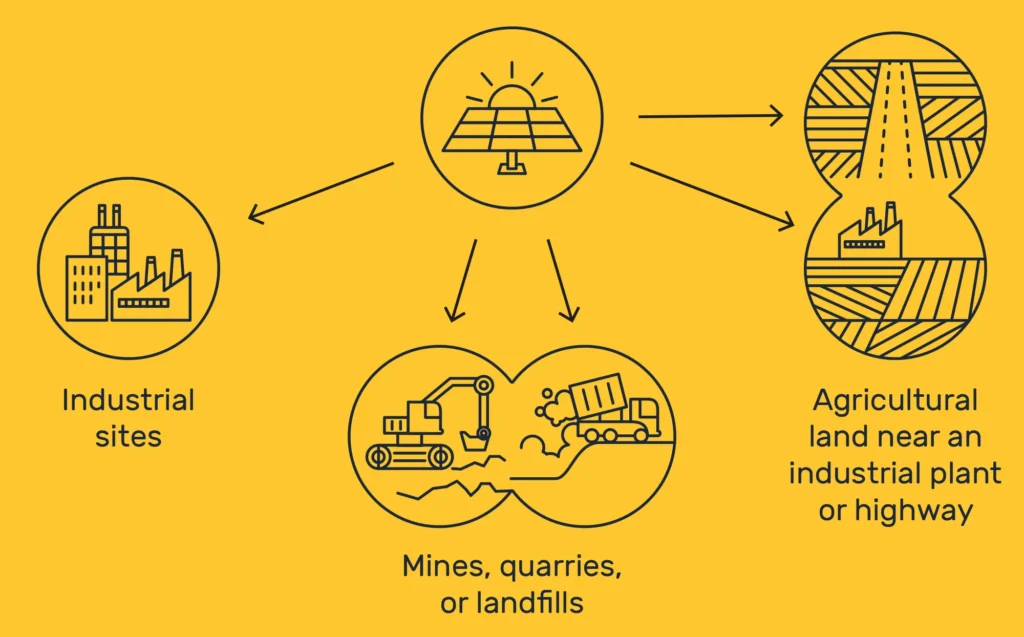
GDS Sole Italie is the Italian subsidiary of Générale du Solaire, an independent French group founded in 2008 with a clear mission: producing clean solar energy from land that is often overlooked (decommissioned industrial areas, quarries, degraded soils, land adjacent to production facilities) and returning it to stable, long-term productive use.
On agricultural land, this same logic translates, in most cases, into advanced agrivoltaics: energy production, farming and livestock coexisting on the same soil.
In both cases, the principle is the same: land that generates value, in a stable way and in harmony with its surroundings.
GDS Sole Italie's approach is not that of an installer or a technology supplier. It is that of an operator that takes responsibility for the entire lifecycle of a plant: from identifying suitable land to operational management over 30–35 years, including the permitting process, financing and construction.
The landowner does not need to invest anything, nor handle any administrative procedures. GDS Sole Italie manages every phase of the process.
GDS Sole Italie plants
Ground-mounted photovoltaics and agrivoltaics: environmental integration practices

Large-scale solar power plants: what they are and how they work

What is a ground-mounted photovoltaic plant?

A ground-mounted photovoltaic plant is an electricity generation facility powered by solar energy, installed on open land. Unlike small-scale domestic or industrial systems, utility-scale plants are significantly larger: the term generally applies from 1 MWp of capacity, though the most efficient and impactful projects often exceed 5 MWp and require land areas in the order of tens of hectares. The energy produced is not consumed on-site: it is fed into the grid and sold on the electricity market, contributing to the national energy transition targets set out in the National Integrated Energy and Climate Plan (PNIEC).
Scale is the key difference: to produce meaningful amounts of energy — enough to power thousands of households — significant land areas, substantial investment capacity, and specialised expertise in managing the entire plant lifecycle are required, from design through to routine and extraordinary maintenance, over the full operational lifespan.
The main challenges are territorial and regulatory in nature: not all land is eligible, and constraints exist related to landscape, environmental, hydrogeological, archaeological, or natural and cultural heritage protection. The permitting process is lengthy and technical, requiring demonstration of the land's suitability and that the project adequately addresses those constraints. Managing this phase well is often the decisive factor between a project that gets built and one that stalls.

Why a specialist operator is needed

Developing large-scale ground-mounted photovoltaic plants requires highly specialised expertise — such as that held by GDS Sole Italie: an operator capable of managing the entire process, equipped with the necessary technical, legal and financial competencies, and able to take responsibility for projects over decades.
GDS Sole Italie covers the entire value chain: from project development to operational management, including financing and construction. The landowner does not need to handle anything.
Ground-mounted photovoltaics: the permitting process

Tecnologia: impianti fissi e con inseguimento solare (tracker)

I moduli fotovoltaici possono essere installati su strutture fisse, orientate in modo permanente
verso sud, oppure su sistemi di inseguimento solare a un asse (tracker), che seguono il percorso del
sole nel corso della giornata. I tracker aumentano la producibilità dell'impianto (indicativamente
dal 15 al 25% rispetto al fisso) al costo di una maggiore complessità meccanica. La scelta tra le
due tecnologie dipende dalle caratteristiche del sito, dalla morfologia del terreno e dalle condizioni
economiche del progetto.

Technology: fixed structures and solar trackers

Photovoltaic modules can be installed on fixed structures, permanently oriented southward, or on single-axis solar tracking systems (trackers), which follow the sun's path throughout the day. Trackers increase plant output (typically by 15 to 25% compared to fixed systems) at the cost of greater mechanical complexity. Today, solar tracking systems have become the most widely used solution in GDS Sole Italie's plants, thanks to their superior performance. Fixed structures nonetheless remain a valid alternative under specific conditions: sloped terrain, particular technical constraints, or specific project requirements.

FIXED STRUCTURES

Tilted southward at an angle depending on the latitude

NOS SOLUTIONS-FIXE

TRACKER

They rotate on an axis and allow solar panels to remain constantly oriented toward the sun, from morning to evening

NOS SOLUTIONS-TRACKER

Do you own land?
GDS Sole Italie can unlock its value.

Owners of agricultural land located near (within approximately 350 m of) industrial facilities, motorways, industrial development areas (ASI zones), decommissioned industrial areas, quarries or remediated landfills will find in GDS Sole Italie a direct and knowledgeable partner.
Regulatory compatibility assessment is part of the preliminary evaluation that GDS Sole Italie carries out.

What GDS Sole Italie offers landowners:

GDS Sole Italie acquires suitable land through two structures:

  • a surface right (diritto di superficie) for a minimum of 30 years
  • direct purchase of the property
In both cases, GDS Sole Italie takes full responsibility for the entire process: from feasibility analysis to permitting, from construction to operation, through to final decommissioning and land restoration.
Once the land agreement is signed with GDS Sole Italie, the landowner is released from any further contractual obligations. At the end of the plant’s useful life, GDS Sole Italie also undertakes full responsibility for dismantling and restoring the site.
terreni per impianti fotovoltaici a terra
Want to understand in detail how the land transfer works, which documents are required and what to expect at each stage? Go to the guide for landowners.
Transferring your land for a photovoltaic or agrivoltaic plant
GDS Sole Italie also works with local partners (professionals, agents, intermediaries) who know the territory and can identify land opportunities or connect interested landowners. If you operate in this field, find out how to work with us.
Become a GDS Sole Italie partner

Plants in operation and projects in development
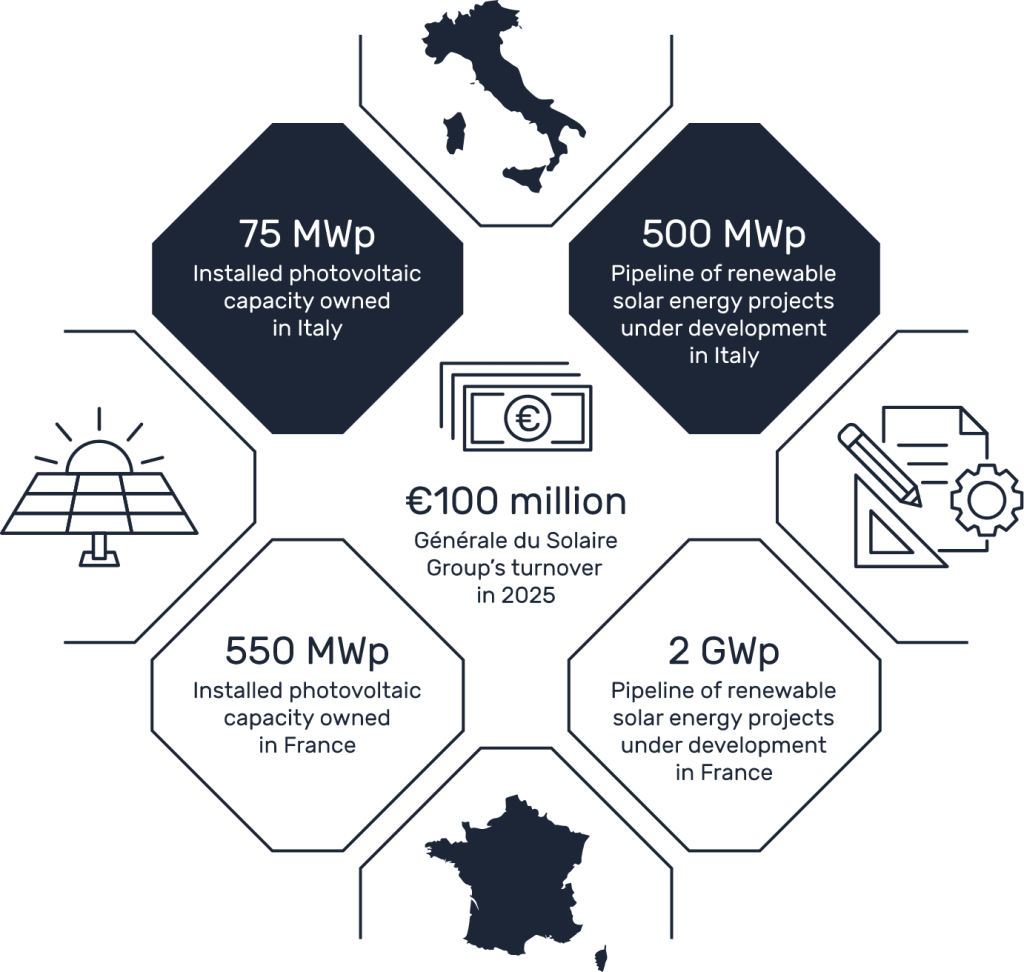
GDS Sole Italie operates in Italy as an IPP (Independent Power Producer) and has already commissioned several photovoltaic plants, with a total installed capacity of approximately 75 MWp.
GDS Sole Italie's pipeline stands at 500 MWp under development, spread across several large-scale plants throughout Italy.
Behind GDS Sole Italie stands the strength of Générale du Solaire: an independent group active since 2008, with 550 MWp self-developed and installed in France and an overall development pipeline exceeding 2 GWp.
A body of technical, financial and operational expertise built over approximately twenty years of completed projects — which GDS Sole Italie brings directly to the Italian market.
Discover one of our projects in Italy and GDS Sole Italie's experience applied in the field.
Ground-mounted photovoltaics: Badia Polesine case study

Frequently asked questions